

The Architecture School Application That Actually Gets You Accepted

Stop treating your application like a checklist and start treating it like a design project.
Here's what most people get wrong about architecture school applications: they think it's about collecting the best individual pieces—strong portfolio, good grades, glowing recommendations—and hoping they add up to acceptance.
But here's what I learned from sitting on admissions committees and reviewing thousands of applications: the ones that get accepted don't just have good parts. They tell a coherent story where every piece reinforces the same narrative about who you are and what you want to explore.
Think of your application like a design project. You wouldn't just throw together your favorite materials and hope they work—you'd choose elements that serve a unified concept. Your application needs the same intentional approach.
The Big Picture: Your Application Is a Branding Exercise
Before you touch your portfolio or write a single word, you need to answer this question: What are you genuinely curious about exploring through architecture?
This isn't about having a "unique value proposition" (you're not a product). It's about identifying an intellectual territory you want to investigate—sustainability, community gathering, adaptive reuse, the intersection of technology and craft, whatever genuinely interests you.
The key word is genuine. Admissions committees can smell fabricated interests from a mile away. They're looking for evidence that you've already been thinking about this topic, not that you picked something impressive-sounding last month.
This becomes your thread—the central theme that connects every part of your application. Your personal statement declares it. Your portfolio proves it. Your grades and recommendations support it.
This Applies Whether You're 17 or 37
The branding framework works for both high school students applying to BArch programs and career changers applying to MArch I programs.
The mindset is identical—only the proof points differ.
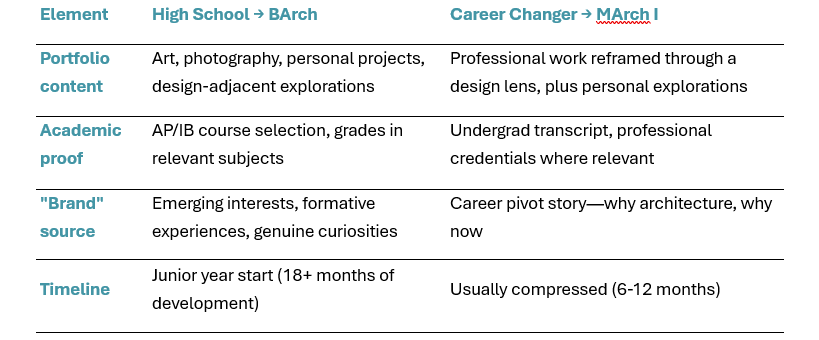
The examples throughout this post will note which audience they're addressing where relevant. But the core principle remains: coherence beats perfection.
The Hierarchy: What Actually Matters Most
Here's where most application advice gets the order wrong. They'll tell you grades come first, or that your portfolio is everything. The reality is more nuanced:
Personal Statement — declares your intellectual territory
Portfolio — proves you've been exploring it
Academics — demonstrates capability in relevant areas
Recommendations — validates your genuine engagement
1+2 works together to create a Brand, while 3 + 4 reinforces this Brand. Let's break each one down.
Personal Statement: Declare Your Territory
Your personal statement isn't an autobiography. It's your declaration of what you want to explore and why you're the person to explore it.
The structure that works:
Specific observation that demonstrates how you already think about space, design, or your chosen theme
Background and experiences that shaped this interest (connected to your thread)
Evidence of action — what you've already done to pursue this curiosity
Vision for your education — how this program specifically will help you go deeper
What admissions committees are reading for:
They're not looking for the "right" interest. They're looking for authentic interest backed by evidence. A student passionate about how public spaces create community is just as compelling as one interested in sustainable materials—as long as both can prove they've actually been thinking about their topic.
The mistake to avoid:
Generic statements about "loving architecture" or being "passionate about design." These tell the committee nothing about how you think or what you'll contribute. Every applicant loves architecture—that's why they're applying.
Portfolio: Prove Your Interest
Here's what high school students (and their parents) often misunderstand: your portfolio isn't supposed to prove you can already do architecture. You haven't studied architecture yet. Of course you can't.
Your portfolio proves that you've been thinking about your declared interest—through whatever medium you have access to.
What this looks like for high school students:
If your thread is "how design brings people together in public spaces," your portfolio might include:
Photography series documenting how people actually gather in your neighborhood (the bench everyone sits on, the corner where kids congregate, the cafe table arrangement that sparks conversation)
Art pieces inspired by artists like Italian street artist Greg Goya, whose work brings moments of unexpected joy into everyday urban life—maybe you created similar interventions or responses
A school project where you analyzed a public space's success or failure
Personal explorations — sketches, collages, observations about spaces that facilitate or hinder connection
None of this is "architecture." All of it proves you've been genuinely investigating your theme.
What this looks like for career changers:
If you're a graphic designer pivoting to architecture, your portfolio might reframe your typography and layout work as investigations of visual hierarchy and spatial organization—then add personal explorations that show you extending those interests into three dimensions.
The quality bar:
Admissions committees aren't expecting professional polish from high schoolers. They're looking for:
Evidence of seeing — do you notice things others miss?
Process and thinking — can you show how you developed ideas, not just final products?
Genuine curiosity — does this feel like authentic exploration or manufactured content?
10-15 pieces that tell a coherent story will always beat 25 random projects that demonstrate "range" but no focus.
Academics: Support Your Brand
Yes, grades matter. But not in the way most people think.
The conventional wisdom: Math and physics grades matter most because architecture involves structures and calculations.
The more accurate picture: The grades that matter most are the ones that support your declared interest.
If your thread is about community and public space, strong grades in geography, sociology, or urban studies might be more relevant than calculus. If you're interested in sustainable design, environmental science becomes crucial. If your interest is in the intersection of art and architecture, your studio art grades carry significant weight.
This doesn't mean you can bomb math. Architecture programs are rigorous, and they need to see you can handle challenging coursework. But strategic course selection that supports your brand—especially for juniors who still have time to shape their transcript—can strengthen your overall narrative.
For high school students: If you're taking AP or IB courses, think about how they connect to your theme. AP Environmental Science supports a sustainability thread. AP Art History supports an interest in how buildings carry cultural meaning. IB Geography supports urban-focused interests.
For career changers: Your undergraduate transcript is what it is. Focus on explaining how your academic background—whatever it was—connects to your architectural interests. A psychology degree isn't a liability if you're interested in how spaces affect human behavior. An engineering degree supports interests in structure and tectonics.
Recommendations: Validate Your Engagement
Choose recommenders strategically based on your thread, not just on who likes you most.
The ideal combination:
Someone who can speak to your intellectual engagement with your declared interest
Someone who can speak to your creative process and how you develop ideas
Someone who can speak to your character—work ethic, collaboration, persistence
The key insight: Brief your recommenders thoroughly. Don't just ask for a letter—give them:
Your personal statement draft (so they understand your thread)
Specific projects or experiences you'd like them to mention
The connection you want them to reinforce between your work and your interests
A recommendation that echoes your personal statement's themes is exponentially more powerful than a generic "great student, highly recommend" letter.

Making It All Work Together: An Example
Let's see how this branding framework plays out in practice.
Example thread: "Design as a catalyst for unexpected public joy"
Personal Statement: Opens with observing how a single painted crosswalk in her neighborhood changed how people moved through the intersection—kids started hopping on the colors, adults smiled, strangers made eye contact. Discusses how she became obsessed with small interventions that shift public behavior. References discovering artists like Greg Goya and beginning to document similar moments of unexpected urban delight in her own city. Explains her interest in studying how architecture and design can create these moments at larger scales. Connects to specific aspects of the program—maybe a professor's research on public space, or a studio focused on community intervention.
Portfolio:
Photography series capturing "moments of unexpected gathering" in her city
A small intervention project—maybe she organized painting a mural on a neglected wall and documented how use of the space changed
Artwork exploring color and movement inspired by street artists
Analysis project from school examining a public space's social dynamics
Sketchbook pages showing observations about what makes some spaces feel alive and others feel dead
Academics: Strong grades in AP Art, AP Human Geography, and honors English (showing both creative and analytical capability). Average grades in math and science (not a red flag, just not the strength). Course selection that demonstrates intentionality.
Recommendations:
Art teacher discusses her observational skills and creative process
Geography teacher speaks to her analytical thinking about urban systems
Community center supervisor (where she organized the mural project) validates her initiative and collaborative skills
The result: Every piece reinforces the same story. The committee finishes the application understanding exactly who this student is and what she'll contribute to their program.
Timeline for Success
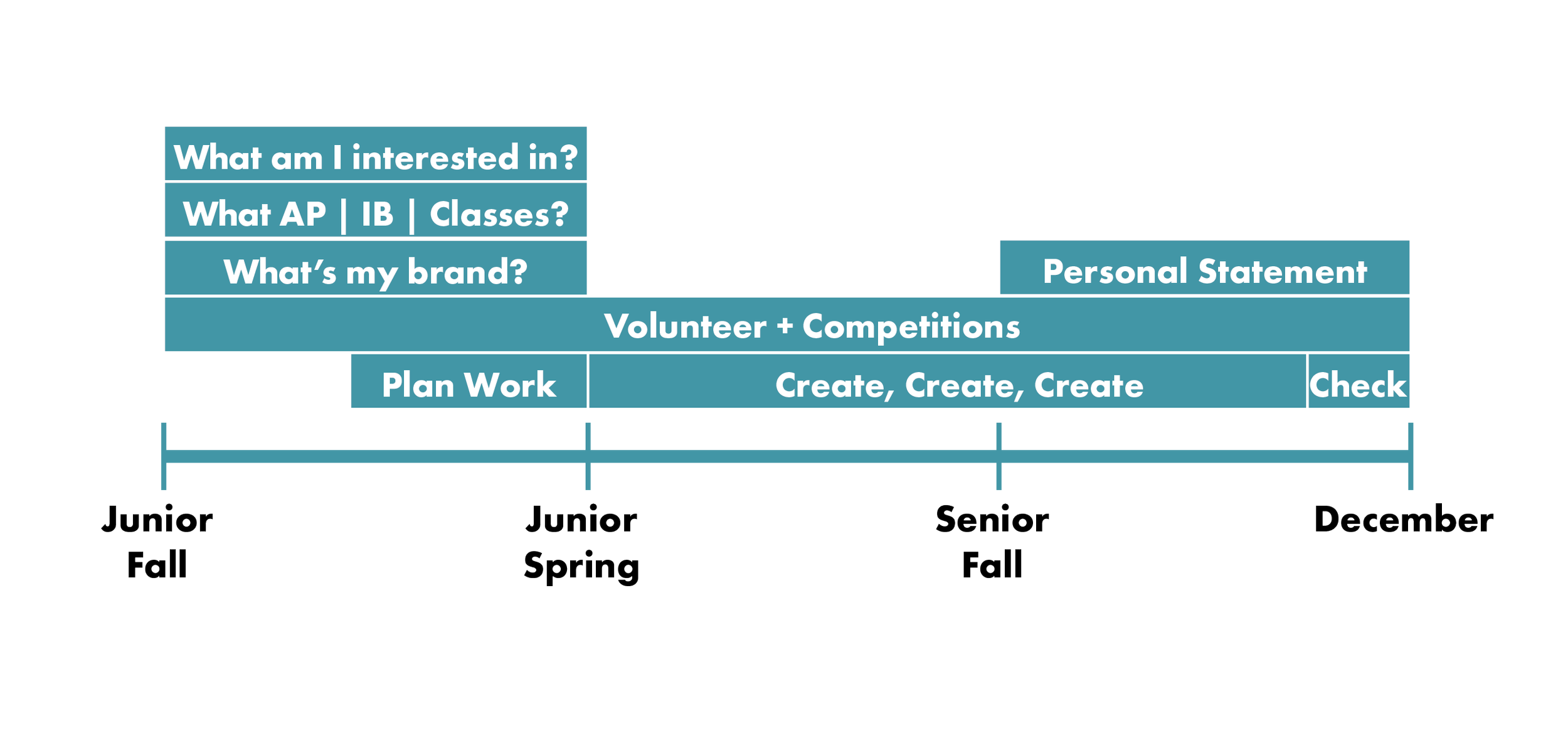
High School Students
Beginning of Junior Year:
Identify your emerging interests and potential thread
Begin documenting observations, creating work, building portfolio content
Select AP/IB courses strategically to support your developing theme
Start researching programs to understand what different schools emphasize
Summer Before Senior Year:
Portfolio development intensive—create new work, curate existing work
Visit schools if possible, attend information sessions
Refine your thread based on your strongest portfolio pieces
Senior Year, Fall Semester:
Finalize personal statement (your thread should be crystal clear by now)
Request recommendations with thorough briefing materials
Submit applications with buffer time for technical issues
Senior Year, Spring Semester:
Prepare for interviews (some programs require them)
Make final decisions based on fit, not just prestige
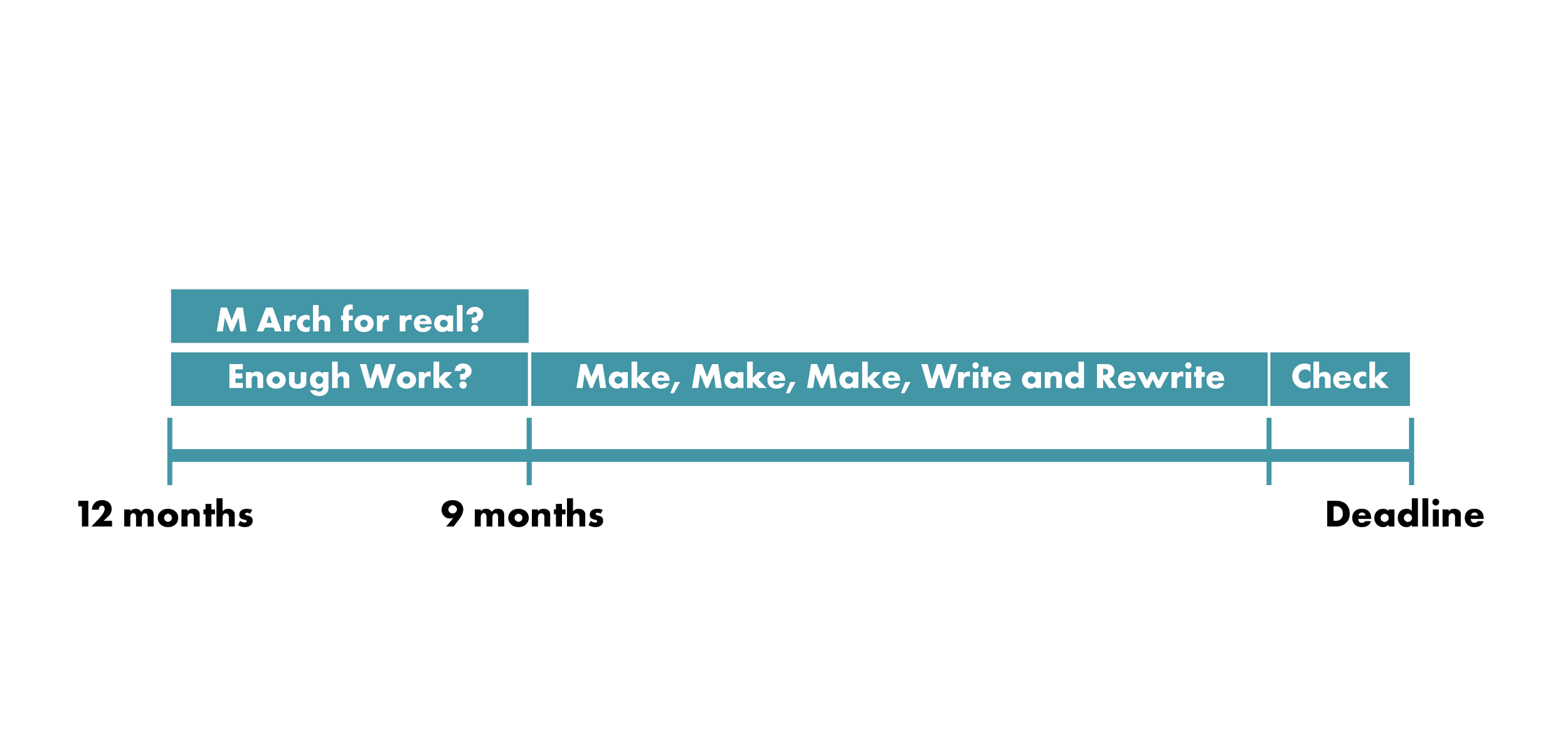
Career Changers (MArch I Applicants)
12 Months Before Deadline:
Clarify your "why architecture, why now" story
Begin creating personal work that bridges your professional background and architectural interests
Research programs for fit with your specific goals
9 Months Before Deadline:
Portfolio development—reframe professional work, add personal explorations
Draft personal statement establishing your narrative
Identify recommenders who can speak to both your professional capability and your design interests
1 Months Before Deadline:
Finalize all materials
Brief recommenders thoroughly
Submit with time for review
Common Mistakes That Kill Applications
The Shotgun Approach: Applying to 15 schools without tailoring applications. Committees can tell when a personal statement could be sent anywhere.
The Prestige Chase: Applying only to "top" schools without considering fit, culture, or what you actually want to study. A program that's perfect for your interests matters more than a famous name.
The Generic Passion: Relying on statements about "loving architecture" rather than demonstrating specific, authentic interests through evidence.
The Disconnected Application: Strong individual pieces that don't tell a coherent story. Great grades, interesting portfolio, solid essay—but no thread connecting them.
The Last-Minute Scramble: Portfolio development takes time. Personal exploration takes time. Rushing leads to applications that feel manufactured rather than genuine.
The Bottom Line
Your architecture school application isn't just about getting accepted—it's about demonstrating that you've already begun thinking like someone who belongs in architecture school.
The students who stand out aren't necessarily the most talented. They're the ones who show up with a clear point of view, evidence of genuine exploration, and an application where every piece supports the same coherent story.
Treat your application like your first design project. Start with a clear concept. Choose elements that serve that concept. Execute with intention and attention to detail.
The schools that accept you should be excited about the specific designer you're becoming, not just impressed by your general qualifications. That happens when your application answers not just "Can this person succeed here?" but "What unique perspective will this person bring to our program?"
That's how you get accepted.
Ready to develop your application brand and build a portfolio that proves your genuine interests? At Archidood, we help aspiring architects craft coherent applications that stand out—whether you're a high school student just starting to explore architecture or a career changer making the leap. Because acceptance isn't about being perfect. It's about being authentically, compellingly you.
What's the thread you're building your application around?
Share in the comments—it might help you clarify your thinking (and help others see what's possible).
