

BArch vs MArch vs "Which Program Am I Applying For?"
Let's be honest—choosing an architecture school is confusing enough without having to decode an alphabet soup of degree acronyms. BArch, BSA, MArch I, MArch II, 4+2, 5-year... it's like the system was designed to be as unclear as possible.
I get it. When I was researching schools, I spent way too much time trying to figure out what these letters actually meant and how they'd affect my career. Now, having gone through the system and worked with graduates from different programs, I can give you the real breakdown of what these degrees mean for your future.
The First Question: How Certain Are You?
Before comparing degrees, answer this honestly: How committed are you to architecture as a career?
This isn't a trick question. Your certainty level should drive your degree choice more than rankings, prestige, or what your friends are doing.
100% certain, no doubts: The 5-year BArch probably makes sense. It's the fastest path to licensure, and you won't feel constrained by the early commitment.
Pretty sure, but want options: Consider the 4+2 path or a BArch program within a larger university where you could potentially transfer if needed. Flexibility has value when you're investing 5+ years.
Interested but still exploring: A pre-professional undergraduate degree (BS in Architecture or similar) lets you test the waters before committing to a professional program. You'll need grad school to get licensed, but you'll make that decision with more information.
There's no wrong answer here—just honest self-assessment.
The Two Main Paths to Licensure
Path 1: The 5-Year BArch
This is the direct route. Five years, one degree, and you're eligible to start the licensure process immediately after graduation.
The pros:
Faster path to licensure (assuming that's your goal)
Usually less expensive than 4+2 total
Intensive, focused architectural education from day one
Strong studio culture and peer bonds over five years
The cons:
You're committed to architecture from freshman year
Limited opportunity to explore other subjects deeply
If you change your mind junior year, you're essentially starting over
Can feel narrow compared to a liberal arts education
Best for: Students who are certain about architecture and want to get licensed as efficiently as possible.
Path 2: The 4+2 Route
Four years of undergraduate study (often a BS in Architecture or related field) plus 2-3 years of graduate school for an MArch.
The pros:
Flexibility to explore other interests in undergrad
Often stronger liberal arts foundation
Graduate school offers more specialized focus
Can change your mind without losing all progress
The cons:
Takes 1-2 years longer than BArch
Usually more expensive total (graduate school costs)
Two separate applications and transitions
Might feel like you're "behind" BArch graduates initially
Best for: Students who want architecture but also value broad education, or who aren't 100% certain about the field yet.
The Comparison at a Glance
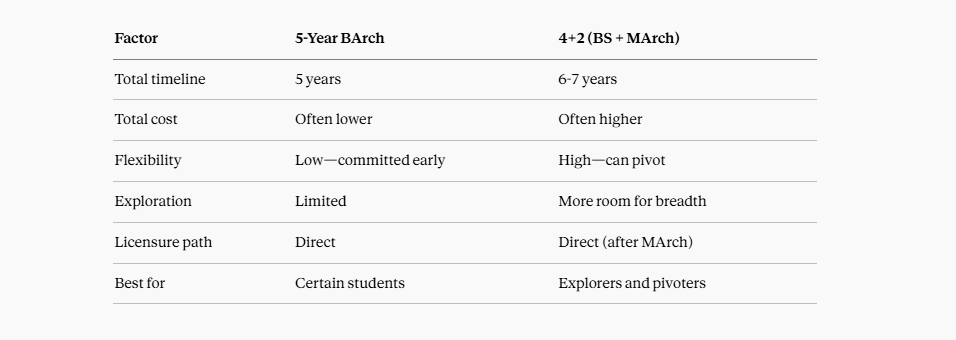
Decoding the Acronyms
Here's your cheat sheet:
BArch (Bachelor of Architecture) The professional 5-year degree. NAAB-accredited, which means you can pursue licensure directly after graduation.
BS/BA in Architecture, BS in Architectural Studies, etc. These are pre-professional undergraduate degrees. They give you architectural education but do NOT qualify you for licensure on their own. You'll need graduate school.
MArch I (Master of Architecture, First Professional) For students who didn't study architecture in undergrad. Usually 3-3.5 years. Gets you to the same professional standing as a BArch.
MArch II (Master of Architecture, Post-Professional) For people who already have a BArch or MArch I. Usually 1-2 years. Focused on specialization or research, not basic professional qualification.
The key question for any degree: Is it NAAB-accredited? If yes, it's a path to licensure. If no, you'll need additional education before you can get licensed.
Why I Chose RISD
For context on how this decision actually plays out: I wanted the efficiency of a 5-year BArch, but I wasn't 100% locked into architecture. I knew I was committed to design—I just wasn't certain which kind.
RISD gave me both:
A professional degree (I could pursue licensure)
Design flexibility (I could have switched to Industrial Design, Furniture, or other majors after foundation year if architecture didn't fit)
That safety valve mattered to me. I ended up staying in architecture, but knowing I had options made the commitment easier.
Your calculation might be different. Maybe you're completely certain and want the most direct path. Maybe you want a traditional university experience alongside your architecture education. The right answer depends on your specific situation.
Factors Beyond the Degree Type
Once you've decided between BArch and 4+2, other factors come into play:
Financial reality Can you afford one more year of tuition? How much debt are you comfortable carrying into a profession that doesn't pay exceptionally well at the entry level? Sometimes the "faster" path is also the more financially sustainable one.
Geographic goals Where do you want to work after graduation? Schools have regional networks and firm relationships. A strong local program might serve your career better than a famous program across the country, depending on your goals.
Learning environment Do you thrive in intensive, immersive environments? Or do you need variety and balance? BArch programs are notoriously demanding. Some students flourish in that intensity; others burn out. Student life, social aspect, sports teams all matter and are part of your college experience.
University vs. design school BArch programs exist at both large universities (Cornell, UT Austin) and dedicated design schools (RISD, SCI-Arc). The educational experience differs significantly—universities offer broader campus life and course options; design schools offer deeper immersion in creative culture.
School program and course Although architecture schools teach similar topics, the focus and experience can be very different. Some will be more design originated, or concept based, some will have a strong structural emphasis, or be focused on theoretical research as appose to a finished physical building. You should do your research and be familiar with the specialties of each school before applying.
Location Location Location
This is one of the most important factors to consider, especially for those determined to do architecture. For architecture students, your inspiration and understanding of the built world come as much from the classroom as it does from your surroundings and environment around you. You will have a very different reading of density and circulation being in New York City vs the suburbs. You might develop an interest in high rises instead of single family houses; a research in small apartment units rather than large retail malls. My advisors back in the day advised me to pick RISD over Cornell based on location; one being in an urban area, surrounded by buildings vs trees and waterfalls.

Cornell University in Ithaca (left) vs Rhode Island School of Design in Providence (right)
For Career Changers
If you're coming to architecture from another field, the MArch I is designed for you.
A few things to know:
No architecture background is required or expected
Your previous career is an asset, not a liability—admissions committees value diverse perspectives
Programs typically run 3-3.5 years
You'll be in class with people of various ages and backgrounds; it's not unusual to be 28 or 35 in an MArch I program
The application process mirrors what we've discussed for undergrads: your portfolio proves your way of seeing and thinking (through whatever medium you've worked in), and your essay explains why architecture, why now.
The Decision Framework
Choose the 5-year BArch if:
You're certain about architecture as a career
You want the most efficient path to licensure
You thrive in intensive, focused environments
Financial efficiency is a priority
You don't need extensive liberal arts exploration
Choose the 4+2 path if:
You want flexibility to explore other interests
You're not 100% certain about architecture
You value broad undergraduate education
You might want to specialize in graduate school
You're okay with a longer timeline and higher total cost
Choose a pre-professional undergrad if:
You're interested in architecture but want to test it first
You might pivot to a related field (urban planning, real estate, construction management)
You want maximum flexibility before committing to the professional track
The Bottom Line
The degree type matters less than most people think. Both BArch and MArch lead to the same destination—licensed architect—just through different routes with different tradeoffs.
I've worked with excellent architects from 5-year programs and excellent architects from 4+2 paths. I've seen people thrive in intensive design schools and people thrive in university programs. The degree didn't determine their success; what they did with their education did.
Choose based on your certainty level, your financial reality, and your learning style. Don't choose based on rankings alone, what sounds most prestigious, or what your classmates are doing.
And if you're still confused after reading this? That's okay. Reach out to current students at programs you're considering. Visit campuses if you can. Talk to architects who took different paths. The more information you gather, the clearer your decision will become.
Trying to figure out which path fits your situation? At Archidood, we help aspiring architects navigate education decisions and build applications that reflect who they actually are—not who they think admissions wants them to be.
